Squash courts are confined spaces, and both players need to move freely. Understanding interference rules is crucial for safe and fair play.
1. The Game Objective & Court Zones
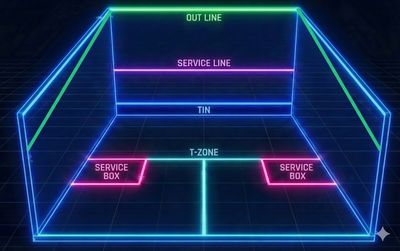
🎯 The Basic Goal
- 👉 Hit the Front Wall: Every shot must eventually hit the front wall *between* the top Out Line and the bottom Tin.
- 👉 Two Bounces = Point: Your opponent must return the ball before it bounces on the floor twice.
🏗️ Key Court Zones
-
🟥The Out Lines Top boundaries on all walls. Hitting on or above ANY line is "Out".
-
🔉The Tin The lower boundary on the front wall (like a tennis net). Hitting it makes a loud noise and is a foul.
-
⭐The "T" Zone The intersection in the middle. This is the strategic center you should return to after every shot!
2. How to Score (PAR-11 System)
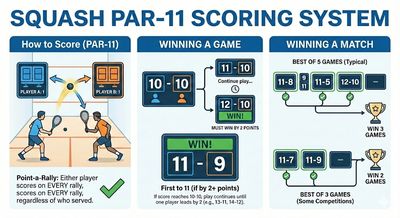
Modern squash uses the PAR-11 (Point-a-Rally) scoring system. This means points can be scored by either player on every rally, regardless of who served.
-
1
Winning a Game
The first player to reach 11 points wins the game, but must win by at least 2 points. If the score reaches 10-10, play continues until one player leads by 2 points (e.g., 12-10, 13-11).
-
2
Winning a Match
Matches are typically played as the best of 5 games (first to win 3 games). In some competitions, matches may be best of 3 games.
3. Why the ball doesn't bounce? (The Cold Ball)
This is the #1 confusion for beginners. Understanding this will save you hours of frustration!
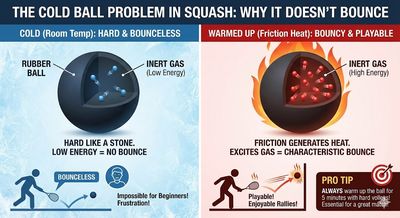
Squash balls are not like tennis balls. Inside a squash ball is inert gas, not air. When the ball is cold (room temperature), the gas molecules are less energetic, making the ball feel extremely hard and bounceless—almost like hitting a stone. A cold ball will barely bounce above the floor, making it nearly impossible for beginners to keep rallies going.
The ball needs to be heated up through friction to become playable. As you hit the ball repeatedly against the walls, the friction generates heat, which excites the gas molecules inside. Only then does the ball develop its characteristic bounce and become enjoyable to play with.
4. Safety & Interference
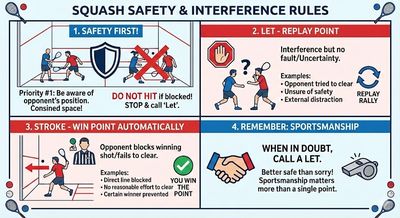
Three Types of Interference Calls
🔄 Let
Result: Point is replayed from the last serve or rally.
- ✓ Your opponent is in your swing path but made a genuine attempt to clear
- ✓ You were unsure if the ball would hit your opponent
- ✓ An external distraction occurred (ball from another court, etc.)
❌ No Let
Result: The rally continues or point is awarded to opponent.
- ✗ You could have reached the ball with reasonable effort
- ✗ The interference was minimal and didn't affect your shot
- ✗ You stopped play unnecessarily
🎯 Stroke
Result: You win the point automatically.
- ✓ Your opponent blocks your direct line to the front wall
- ✓ Your opponent doesn't make a reasonable effort to get out of your way
- ✓ You would have hit a certain winner if not for the interference
5.The 3 Golden Rules of a Valid Serve
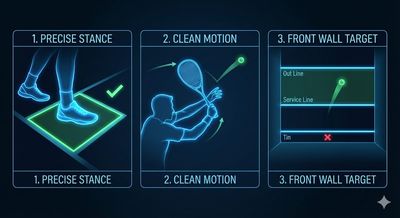
Master these three visual checks to avoid immediate faults.
🦶
1. Precise Stance
- ✅ One Foot In: At moment of impact, one foot must be fully *inside* the box.
- 🚫 No Touching Lines: That foot cannot touch boundary lines.
- ⚓ Grounded: It must stay on floor until ball is hit. (Other foot is free!)
👋🎾
2. Clean Motion
- ✅ Toss/Drop First: You must release the ball before hitting.
- 🚫 No Early Wall Touch: Ball can't hit walls before racket contact.
- 🚀 Direct Path: Must fly straight to Front Wall after hit.
🎯
3. Front Wall Target
- ✅ Green Zone: Hit *between* Service Line and Out Line.
- ⚠️ Fault: Hitting the lines themselves is Out.
- ❌ Lose Point: Hitting the Tin (bottom) is an immediate loss.